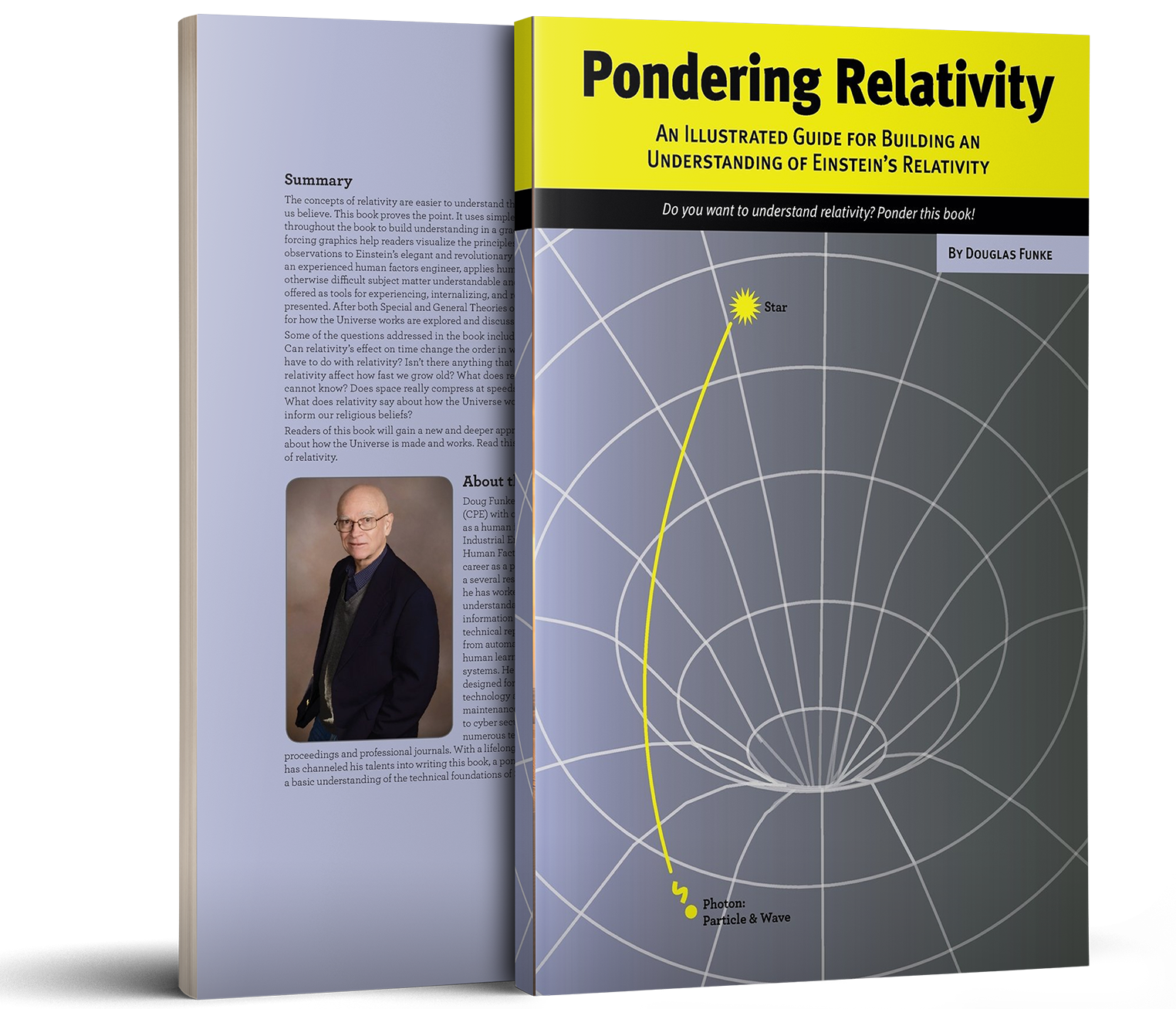
Douglas Funke

Pondering

Relativity

AN ILLUSTRATED GUIDE FOR BUILDING AN UNDERSTANDING OF EINSTEIN'S RELATIVITY

Lorem Ipsum is simply dummy text of the printing and typesetting industry. Lorem Ipsum has been the industry's standard dummy text ever since the 1500s.

Douglas Funke
About The Author

Lorem Ipsum is simply dummy text of the printing and typesetting industry. Lorem ummy text ever since the 1500s, when an unknown printer took a galley of type and scrambled it to make a type specimen book.It was popularised in the 1960s with the release of Letraset sheets containing Lorem Ipsum passages, and more recently with desktop publishing software like Aldus PageMaker including versions of Lorem Ipsum. It is a long established fact that a reader will be distracted by the readable content of a page when looking at its layout. The point of using Lorem Ipsum

About the Book
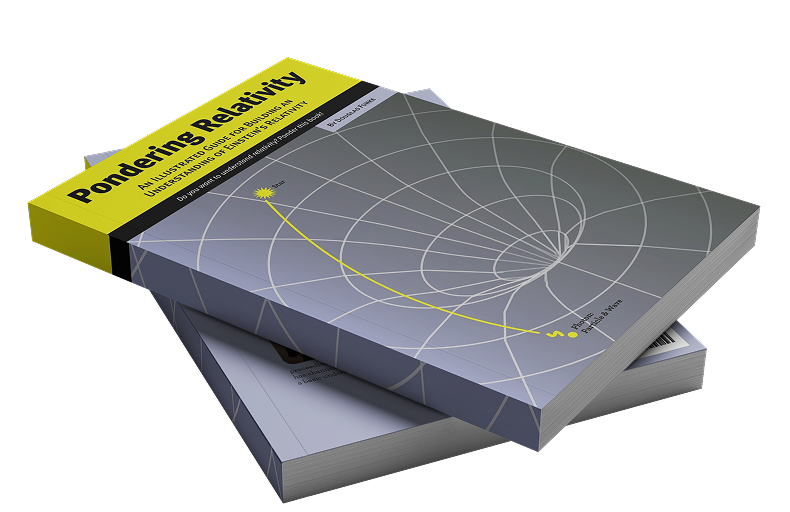
Pondering Relativity

An Illustrated Guide for Building an Understanding of Einstein’s Relativity

Lorem Ipsum is simply dummy text of the printing and typesetting industry. Lorem Ipsum has been the industry's standard dummy text ever since the 1500s, when an unknown printer took a galley of type and scrambled it to make a type specimen book. It has survived not only five centuries, but also the leap into electronic typesetting, remaining essentially unchanged.

ALL CHAPTERS

BOOK CHAPTERS

Chapter

01

When first introduced by physicist Albert Einstein in ıeO5 and later expanded in ıeı5, the theories of relativity were controversial and not universally accepted. Since then, many scientific studies have confirmed the theories’ predictions. Today, relativity is central to our understanding of the Universe.

Read More
Chapter

02

The nature of light and how we experience and measure it are fundamental to understanding the theory of relativity. This chapter describes light and buildsthisfoundation, which also providesimportant insightsinto the size of the Universe. It’s also important to appreciate that light is just a part of the larger electromagnetic spectrum, which includes, for example, radio waves and x-rays.

Read More
Chapter

03

Before Einstein, many scientists believed there was an invisible structure that defined space called the aether. It was believed that, once found, the aether would serve as a common reference for measuring all motion. It was also believed that the aether,represented as a grid in thisillustration, wasthe medium through which light waves traveled. Today, we know that there is no aether defining space.

Read More
Chapter

04

The speed of light is measured within a train car. This is done using a special (imaginary) stopwatch capable of measuring extremely short periods of time. The scientist measures the speed of the photon as it goes from the light bulb on the ceiling to the mirror on the floor and back to the ceiling. As expected, the photon is found to be traveling at speed “c.”

Read More
Chapter

05

Hypothetical clocks that use the movement of light as a measure of time provide significant insight into how relativity works. In light-clocks, the movement of light inside the clock serves as the oscillator.

Read More
Chapter

06

First how long doesit take the rocketship to travel from the Earth to the star as measured from the Earth / star frame-of-reference (the lower stopwatch)? This is easy just like figuring out how long it will take to drive somewhere when the distance and driving speed are known. For example to figure out how long it will take to drive ı20 miles at 60 miles per hour you would divide ı20 miles by 60 miles per hour to figure out that it would take 2 hours

Read More
Chapter

07

Is the bucket spinning, or isthe Universe spinning around the bucket? Could a “spinning” bucket just as easily be considered to be stationary with the Universe spinning around it in the opposite direction? If it is the Universe spinning around the bucket, then to explain the centrifugal forces experienced, Einstein concluded that motions involving accelerations are diWerent from uniform motion and cannot be described by Special Relativity. He developed General Relativity to explain the centrifugal forces.

Read More
Chapter

08

Adding dimensions affects geometry in unexpected ways. Going from two to three dimensions creates geometric anomalies that cannot be easily predicted or understood when only considering two dimensions. This is similar to going from our accustomed three-dimensional space to four-dimensional space-time.

Read More
Chapter

09

Time and aging. Relative motion, acceleration and gravity affect the rate of time passage and can even affect how fast we age. This section describes the effects of relativity on aging using Einstein’s twin paradox. It illustrates how relativity affects the rate of aging.

Read More
Chapter

10

Locations are defined by a spatial coordinate and a time coordinate. Time and space exist together, so locations and events must have a spatial component and a time component. This is shown here on a space-time diagram. We can control our movements through space, but not time

Read More
Chapter

11

In spite of hislowly position as a patent clerk, Einstein published hisinitial proposals about Special Relativity in the respected German journal “Annalen der Physik” in ı905. These ideas elicited some discussion in Germany, but were all but ignored elsewhere.

Read More
Chapter

12

The early stages of Universe evolution. The evolution of the Universe began with the Big Bang and evolved over the subsequent billions of years to create many forms of matter and energy, and ultimately self-replicating molecules that formed the basisfor early life

Read More
TESTIMONIAL

WHAT THEY SAY ABOUT US?

Margaret A. Saleh

AUTHOR

“I seriously felt smarter with every page I turned. Physics always alluded me. This book is well organized, and explains the Theory of Relativity (and MANY related forces) in a manner that allows the non-scientist to digest and understand.”

★★★★★
TESTIMONIAL

WHAT THEY SAY ABOUT US?

Buffalo Shopper

WRITER

“I’m no math scholar, and algebra is what I remember from school and still use… but that’s all I needed. I recommend this book to anyone who wants to actually understand what relativity is all about!”

★★★★★
TESTIMONIAL

WHAT THEY SAY ABOUT US?

-J P Freniere-

AUTHOR

I began this book with some trepidation, not having a background in physics or metaphysics, but since the book’s terminology can by understood by an average high school student I was able to keep up with the help of illustrations and recurring catch phrases, e.g., “moving clocks run slow.” I appreciated the history behind some of the concepts and their development. This is not a book, however, in which one can skip chapters. Best of all, the book clarifies for me some of the dialogue between Doc Brown and Marty!

★★★★★
TESTIMONIAL

WHAT THEY SAY ABOUT US?

Louise Bacon

WRITER

When I went to high school in the early 1940s, the theory of relativity was never mentioned. The big news those days was they had proved that atoms really did exist. Now, at over 90 years old, I am enjoying, and understanding relativity with only high school math to help me. This book has opened up an understanding of what future explorers will have to know to explore space. This is an easy to read and comprehend explanation of Einstein’s theories.

★★★★★
About the Book
Pondering Relativity

An Illustrated Guide for Building an Understanding of Einstein’s Relativity

Lorem Ipsum is simply dummy text of the printing and typesetting industry. Lorem Ipsum has been the industry's standard dummy text ever since the 1500s, when an unknown printer took a galley of type and scrambled it to make a type specimen book. It has survived not only five centuries, but also the leap into electronic typesetting, remaining essentially unchanged.